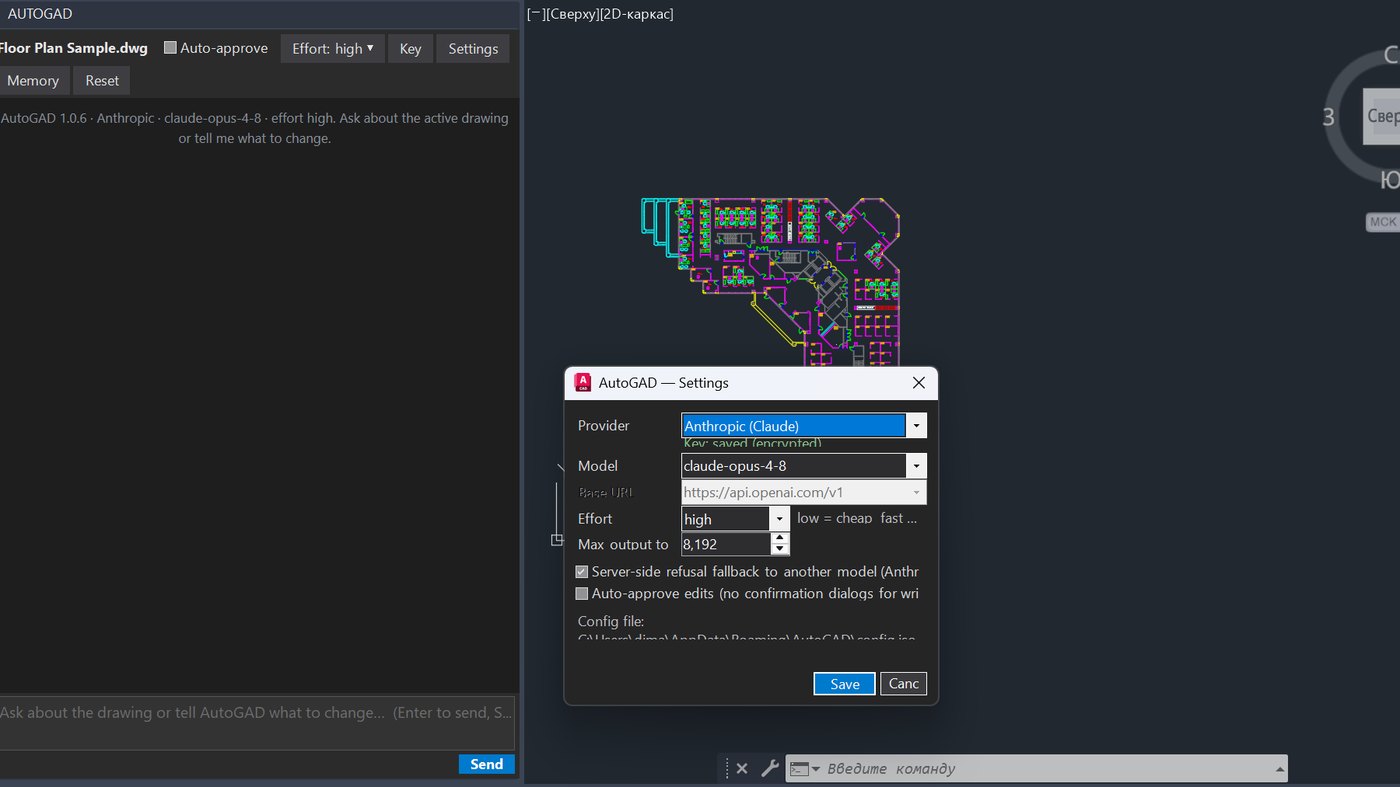
Can Claude work in AutoCAD, check and draw?
Yes — with the AutoGAD plugin. A normal chat cannot open DWG files and cannot see your AutoCAD; the plugin does the reverse and brings Claude into AutoCAD. It sees the whole open drawing — layers, layouts, blocks, tables, text — and answers from what is actually drawn, not from a picture.
What it checks today:
- Quantities. How many fixtures or devices of each type are on the plan — and whether that matches the schedule.
- Schedules and bills of materials. Missing items, extra rows, inconsistent tags.
- Layers. What is frozen or off, which objects sit on the wrong layer.
- Text across the whole drawing. Project codes, sheet names, title blocks, leaders, table cells — find every occurrence and replace them in one confirmed pass.
- Electrical and lighting calculations. Panel loads, design currents, breakers, cables — with the formula and the source data.
And it draws. From a description — "draw a 6000×4000 plan, 200 walls, a 900 door, dimensions" — it draws walls, doors, windows, dimensions, labels and hatches by layer, in the drawing's units, in one confirmed step. From a photo or scan of a sketch (📎, Ctrl+V) it redraws from the numbers, and traces a picture without dimensions into lines on your computer. Drawing from a description and from images arrived in version 1.0.8.
Codes and standards. Claude knows them and can check the current edition online; your company standards it remembers and applies. Every calculation is shown with the formula and the clause it relies on, so the engineer can check and sign.
What it does not do. It does not sign for the engineer and does not replace a survey: a trace of a photo follows the picture.
What Claude can do in your drawing
| You type | What happens |
|---|---|
| "How many VPD projectors and SKR linear fixtures are installed?" | counts the real block references on the plan |
| "Calculate the panel load and pick breakers per outgoing line" | a calculation with formulas from the schedule data |
| "Check the schedule against the drawing" | compares the table with what is drawn, shows the differences |
| "Replace project code K2.AHP-2.2025 with K2.AHP-3.2025 everywhere" | replaces in text, title blocks, leaders and tables — after your confirmation |
| "Freeze the telecom layers" | layer management — confirmed too |
| "Draw a 6000×4000 room plan, 200 walls, a 900 door, dimensions" | draws walls, door, dimensions and labels by layer — in one confirmed step |
| (pasted a photo of a sketch) "Redraw it at 1:1" | redraws from the sketch's numbers or traces the picture into lines |
| "Rotate the selection 15° and copy it 2000 to the right" | edits what is drawn: move, copy, rotate, mirror, offset |
| "Remember that I size cables for 380 V and cos φ 0.95" | remembers it on your next projects |
Before every edit a window lists the exact changes: Allow, Allow all this session or Reject. Plain Undo (Ctrl+Z) reverts any edit. Nothing is written into the file except what you approved.
Memory, cost and privacy
Memory. Claude remembers your rules and habits (voltages, cable types, how you like your answers) and the specifics of each drawing (project code, what layers and blocks mean, decisions made). The notes stay on your computer and survive renaming the file. Nothing is written into the drawing itself.
Where the drawing goes. Nowhere: the DWG file is not sent. Claude receives a short description of the drawing and your messages — nothing else. Nothing is sent to the plugin author: no telemetry.
Cost. The plugin is free. The model usually costs a few cents per question; the cost of every answer is printed under it.
Key. Stored encrypted on your computer under your Windows account.
Requirements
- AutoCAD 2025 or 2026 on Windows. AutoCAD 2024 and older, and AutoCAD LT, are not supported.
- A Claude key (Anthropic site) — or an OpenAI key if you want ChatGPT.
- Internet access for the model's answers.
- The plugin itself is free: open source AGPL-3.0, installer and every version on GitHub.
Working in FreeCAD? There is FreeGAD — the same Claude inside FreeCAD 1.0/1.1.